Decca Finch
All the Bright PlacesDecca Finch, the youngest child in the Finch family, is eight years old when Theodore Finch describes her at home. She appears through small, specific acts: provoking her mother to see if she is listening, filling her room with collections and artwork, and turning an evening of sledding into a race she can win. Her scenes offer a child’s perspective on the family’s fractures, but also show the joking, protective intimacy between her and Theodore.
Identity and Family Background
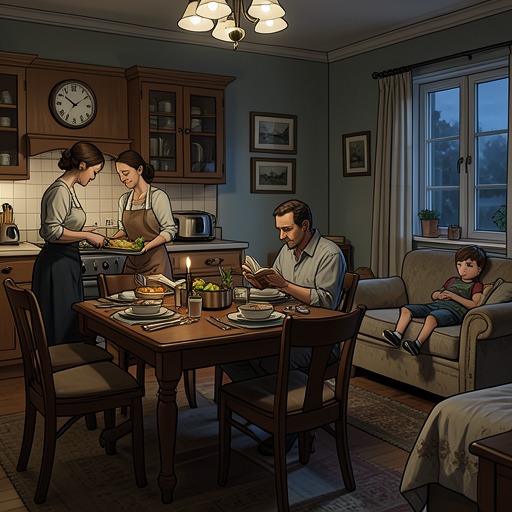
Theodore Finch has two sisters: Kate Finch, one year older than him, and Decca, who is eight. Their parents have divorced, and Theodore’s account places family life in its aftermath. Dinner with Decca and their mother, Mrs. Finch, becomes a recurring household tradition after the separation. The children’s Sunday visits to their father, Ted Finch, are different: they travel together in silence to his new house, where he lives with Rosemarie and her son. The routine is described as obligatory, and the siblings leave with little sense that the meal has brought the family closer.
Theodore’s narration is affectionate but not idealizing. He reports that Decca has realized that she was born after her older siblings, and that she swears more often lately to provoke a response from their mother. During dinner, Mrs. Finch asks about school as a dutiful opening, but initially gives Decca only half her attention. Decca’s attempts to draw her into the conversation suggest a child alert to the difference between being asked a question and being heard.
Imagination, Mischief, and Art
Decca’s room reflects the abundance and disorder of her interests. It is large and strewn with clothes and books; she keeps lizards, beetles, flowers, bottle caps, stacks of candy wrappers, and American Girl dolls left over from an earlier phase. Her artwork covers the walls, alongside a Boy Parade poster. The dolls have stitched chins resembling the stitches Decca herself received after a playground accident, a small connection between the objects she keeps and her own life.
Her inventiveness also shapes the way she tells stories. At dinner, she recounts how a boy named Jacob glued himself to his desk to avoid a science quiz. She treats the episode as deserved and watches for her mother’s reaction. Mrs. Finch, initially distracted, begins paying attention when Decca continues. The story is comic in its telling, but its place in the scene matters: Decca is using an outrageous school anecdote to claim the attention that the family’s ordinary question has not yet secured.
Another of her projects turns books into material for collaboration. Theodore finds her on the floor cutting words from books collected around the house, including their mother’s romance novels. He asks for scissors and chooses from roughly eighteen pairs gathered on her desk. Sitting opposite Decca, with their knees bumping, he asks her for the rules of the project. She sets the task: remove the mean parts and the bad words. The episode gives her a clear authority within their shared activity. Theodore does not simply watch her work; he asks how to join it, and she decides what the work is for.
The Sibling Bond with Theodore
Theodore’s relationship with Decca moves easily between teasing, care, and shared play. Before going upstairs, he checks on her, even though he calls her room a chamber of horrors. On the floor together, they work side by side on her cut-up text project. Their physical closeness is unceremonious: their knees touch, and the scene proceeds as a familiar collaboration rather than a formal exchange between older and younger siblings.
During the last Sunday of spring break, snow covers the ground again. Theodore helps Decca build a figure made partly of snow and partly of mud, then walks with her to the hill behind his grade school. They sled down it repeatedly, and Decca wins each race because it makes her happy. On the walk home, she checks whether he let her win. He reassures her that he did not and puts an arm around her shoulders; she does not pull away. The moment joins competition to reassurance: Decca wants the victory to be real, while Theodore’s answer and easy gesture affirm their closeness without diminishing her achievement.
That warmth contrasts with the strained Sunday dinner at Ted Finch’s new home. When Ted becomes annoyed during the meal, Kate Finch defends Theodore’s right not to eat something he does not want. Back at home, Decca says plainly that the visit was not enjoyable and stomps upstairs. Her response is brief, but it confirms that the family’s ritual has not persuaded her to pretend the occasion was pleasant. The children’s separate reactions—Kate’s explicit objection, Decca’s blunt refusal, and Theodore’s awareness of the performance—show how each sibling registers the same divided family setting.
During Theodore’s Disappearance
When Violet Markey visits the Finch home because Theodore has stopped responding, Decca answers the door. Violet recognizes the family resemblance in her short dark hair and blue eyes, which she shares with Theodore and Kate. Inside, Decca is watching television while Violet searches for signs of Theodore and asks about their mother. When Violet tells her that Theodore is not there, Decca responds that he sometimes goes away and insists that he will return, as he always has. Her certainty rests on a familiar pattern of absence and return; she understands this disappearance through what Theodore has done before, not through what Violet fears may have changed.
A later visit gives that expectation a more unsettled setting. Mrs. Finch is lying on the couch with her eyes closed while Decca arranges pieces of paper across the floor. Violet notices that the activity recalls Theodore’s Post-its, though Kate calls it another of Decca’s art projects. The resemblance is suggestive without establishing that Decca intends to imitate him: paper, which has been part of Theodore’s private way of arranging thoughts, also appears in his sister’s independent creative life. The family has left his room as it was in case he comes back, while Decca continues making something on the floor nearby.
What Theodore Leaves Her
Theodore’s email to his family, sent at 9:43 a.m., recalls a childhood meal in Indianapolis when the family was happy together. Its messages are directed individually to his mother and sisters. To Decca, he offers the idea that difficult words can contain beauty depending on how they are read. The sentiment connects with her earlier book-cutting project, in which she chose to remove mean or bad words, but the two gestures remain distinct: her rules govern a game she created with Theodore, while his email leaves her a private encouragement within a farewell to the family.
Decca’s place in the novel is defined less by explanation than by these recurring actions and objects. She tests whether her mother is listening, fills her room with collections, gives Theodore the rules for a shared project, races him down a snowy hill, and expects him to return when he goes away. The novel does not supply her later response to his death in these scenes. Instead, it preserves the ordinary evidence of their bond: the scissors on her desk, the papers on the floor, the arm around her shoulders, and the confidence that her brother will come back.